
Neuqua’s English department is full of people who teach stories. From “Exit West” to “Othello,” teachers guide students through what makes stories compelling.
But in the past few months, two of those teachers released stories of their own. Mr. Rossi published his young adult novel “Mercutio and Juliet,” and Ms. Hindi released her poetry collection “today, i heard my angel cry.” Both works are self-published on Amazon, allowing students to see another side of Neuqua’s English teachers.
Mr. Rossi’s novel follows Rian Folie, a neurodivergent teenager navigating mental illness, family dynamics, and the complexities of adolescence in a fictional Chicago suburb. The book deals frankly with depression, anxiety, and suicidal ideation, but Rossi was determined not to let the story collapse into hopelessness.
“These are heavy themes,” Rossi said. “But so much of dealing with depression in a clinical sense is about intervening in the moment of crisis and shifting your perspective. There’s hope, and I wanted the book to reflect that.”
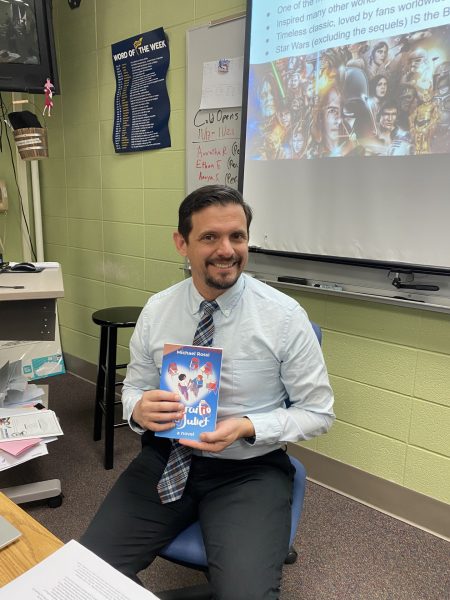
At 16, Rian has been given an ultimatum after jumping out of a moving car: control his behavior, or get sent to a treatment facility. He ends up in an intensive outpatient program alongside other teenagers struggling with their own crises, where he meets a girl named Aurora Diaz. To win her over and prove he is capable of change, Rian convinces the group to stage a production of “Romeo and Juliet”—turning their therapy sessions into rehearsals.
Several scenes in the novel are drawn from Rossi’s own adolescence. He recounted one painfully memorable moment from his own high school years: standing in front of his English class to recite a poem he had written for a girl—a girl who was sitting in that very classroom, watching—only to realize mid-performance that he had not actually memorized it.
“It was worse than what happens in the book,” Rossi admitted. “I’ve always believed in grand gestures.”
That belief, even when disastrous, became central to Rian’s character—a teenager whose impulses constantly outpace his judgment.
The novel’s title reflects Rossi’s long-standing fascination with Mercutio from “Romeo and Juliet”—the charismatic, sharp-tounged character who speaks in torrents and dies for principle despite mocking nearly everything.
“Mercutio should have been the lead,” Rossi said. “He’s more interesting than Romeo. He contains contradictions—he’s totally irreverent, but he takes certain things very seriously. Rian is the same way.” This tension—between humor and seriousness, chaos and meaning—became the foundation for Rian’s voice.
Despite weaving Shakespeare throughout the book, Rossi admits he hated the plays as a teenager.
“I was exactly Rian,” he said. “When [Rian] throws the book out the window after reading one page, that was me. But repetition gets through to you. Over time, Shakespeare became beautiful to me.”
Rossi wrestles with whether Shakespeare still belongs in the curriculum when students’ relationships with language has changed so dramatically—when they think in “6-7”s and short-form content rather than dense, archaic text. The book ultimately argues that every generation should adapt stories to fit their world, just as Shakespeare did with the stories he inherited.
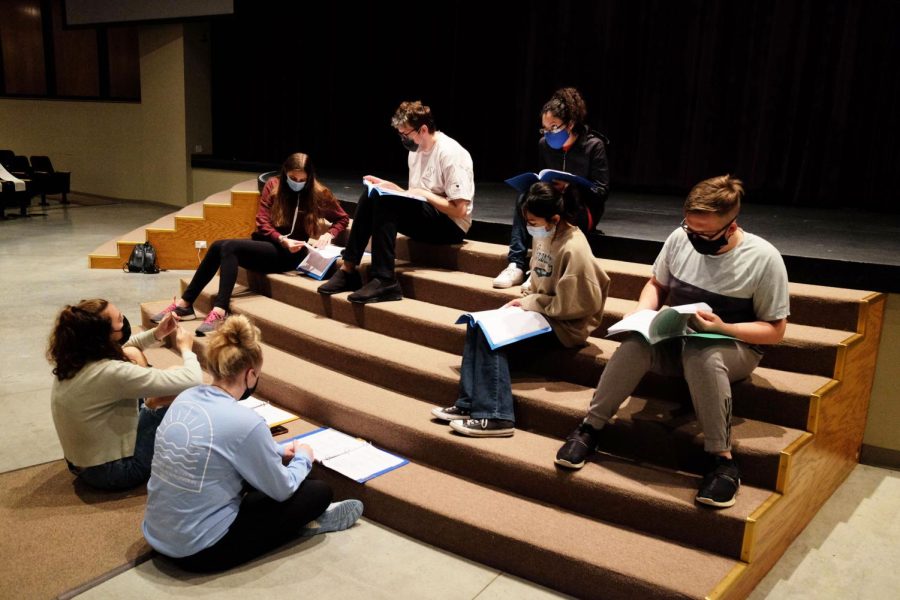
Because Shakespeare wrote for the stage, theater becomes central to the novel as well. For Rian and the other characters struggling with overwhelming emotions, acting becomes therapeutic—a way to work through their emotions without being consumed by them.
“Art allows you to experience emotions without being overwhelmed,” Rossi explained. “Theater lets Rian step out of his own thoughts and understand what love actually is.”
The Midwest setting was equally deliberate. Rossi sees a particular kind of patience and compassion in Midwestern people that makes them compelling to write about—like Rian’s counselor, who endures endless chaos from her students and simply keeps going.
“She just endlessly indulges all the ridiculous things,” Rossi said. That patience of hers becomes essential to Rian’s progress.
Rossi is already working on his next novel, one about runners and mythology, and he plans to release a short-story collection next year. But “Mercutio and Juliet” represents years of teaching, listening, and observing how teenagers build meaning from chaos.
“Books start with the writer,” Rossi said, “but they belong to the reader. Anyone who reads it—that’s incredibly gratifying.”
Another writer at Neuqua is Ms. Hindi, an English teacher at the main building. Unlike Mr. Rossi, Ms. Hindi published a poetry book called “today, i heard my angel cry.” It overflows with raw emotions, such as love and grief. In less than 170 pages, Hindi proves that complicated emotions can bear fruit to lyrical poetry.
Hindi started off her book by dedicating it to her mother. Additionally, her mother is mentioned a couple of times throughout her poems, most noticeably when Hindi brings up this “angel” from the title.
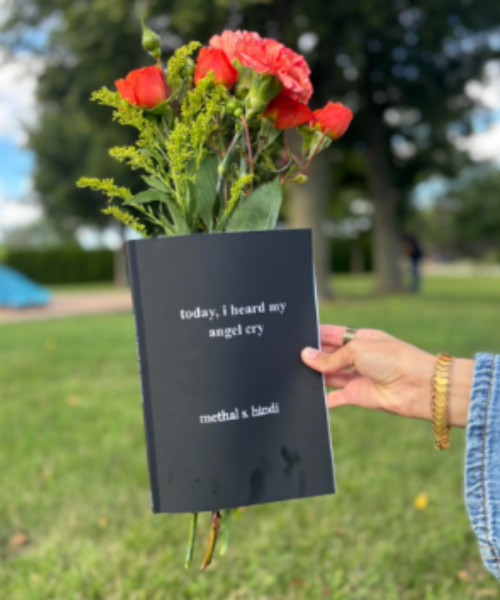
“She used to remind my siblings and I that ‘each shoulder carries an angel’ as a way of showing her love, strength and faith,” shared Hindi.
Her mother essentially gave way to the foundation of her book. Highlighting these similar themes she had carried since her youth made it easier for her to connect her ideas and bring them together to create the title.
“I started to notice that many of my poems echoed that same sense of protection, guidance and love,” said Hindi. “When I saw when I saw those idea overlapped, the title just felt right—it tied everything together.”
However, besides having her mother as inspiration, Hindi did take into account many of her personal experiences, emotions and thoughts as well as her creativity as a writer in her poems. This amounted to the sincere and honest narratives reflected in her writing.
“A lot of my poems come purely from creativity and imagination,” said Hindi. “But many of the poems are also drawn from real moments in my life that I wanted to share and preserve through storytelling.”
Of course, none of this would’ve happened without the guidance and support of her teachers. In her undergraduate poetry class, Hindi had learned to write in many forms—such as villanelles, sestinas and pastorals. As a result of many learned skills, Hindi wanted to make sure that a diverse structure would be clearly visible for her readers.
“The first section reflects those early, highly structured poems, while the later sections move toward a freer, more intuitive style,” said Hindi. “It mirrors my own growth as a poet—learning the rules before learning how to bend or break them.”
Together, their books show how Neuqua’s teachers continue creating long after class ends. Students and families can support both writers by purchasing “Mercutio and Juliet” and “today, i heard my angel cry” on Amazon.